
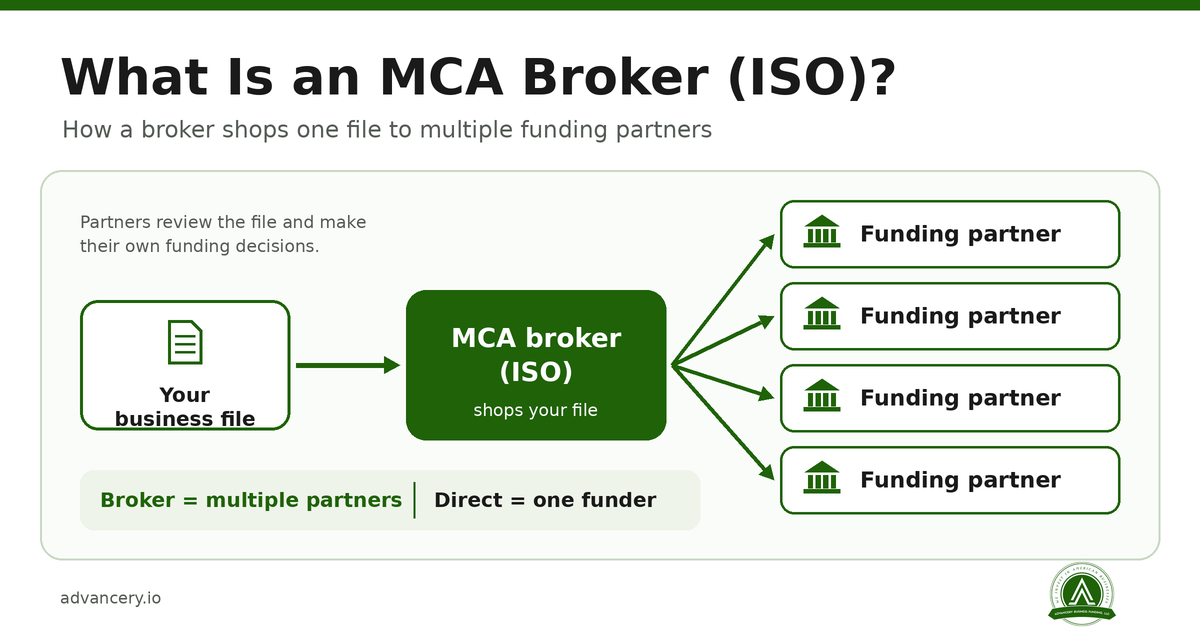
Quick answer: An MCA broker is an independent sales organization (ISO). It takes your business’s funding application and presents it to several merchant cash advance and business funding companies. The broker doesn’t fund the advance. The funding partners review your file, decide whether to make an offer, and set the pricing and terms. Your broker helps you compare those offers and pick one.
If you’ve had a call or email from an “MCA broker” or “ISO,” or you’re trying to decide whether to apply to a funder directly, this guide covers what a broker actually does, how brokers are paid, and what to ask before you sign anything.
Advancery Business Funding, LLC is an independent business funding broker (ISO) in Shrewsbury, NJ. We review your business information and present it to third-party funding partners, who make all underwriting, approval, and pricing decisions. Advancery is not a lender, and funding is not guaranteed.
What is an MCA broker?
An MCA broker sits between a business owner and the companies that provide merchant cash advances (MCAs) and similar products. In the industry, brokers are usually called ISOs (independent sales organizations). The two terms mean the same thing here.
A merchant cash advance isn’t a loan. It’s the purchase of a portion of your future receivables. A funding partner gives you a sum now, and in return it collects an agreed amount from future sales. Collection is usually a percentage of revenue or a fixed daily or weekly remittance. (New to MCAs? Start with what a merchant cash advance is.)
The broker’s job is to:
- Collect your application and supporting documents once
- Review the file for completeness and fit
- Present it to the funding partners most likely to consider it
- Bring the offers back and help you compare them side by side
The broker doesn’t underwrite, approve, price, or fund the deal. Those decisions belong to the funding partner.
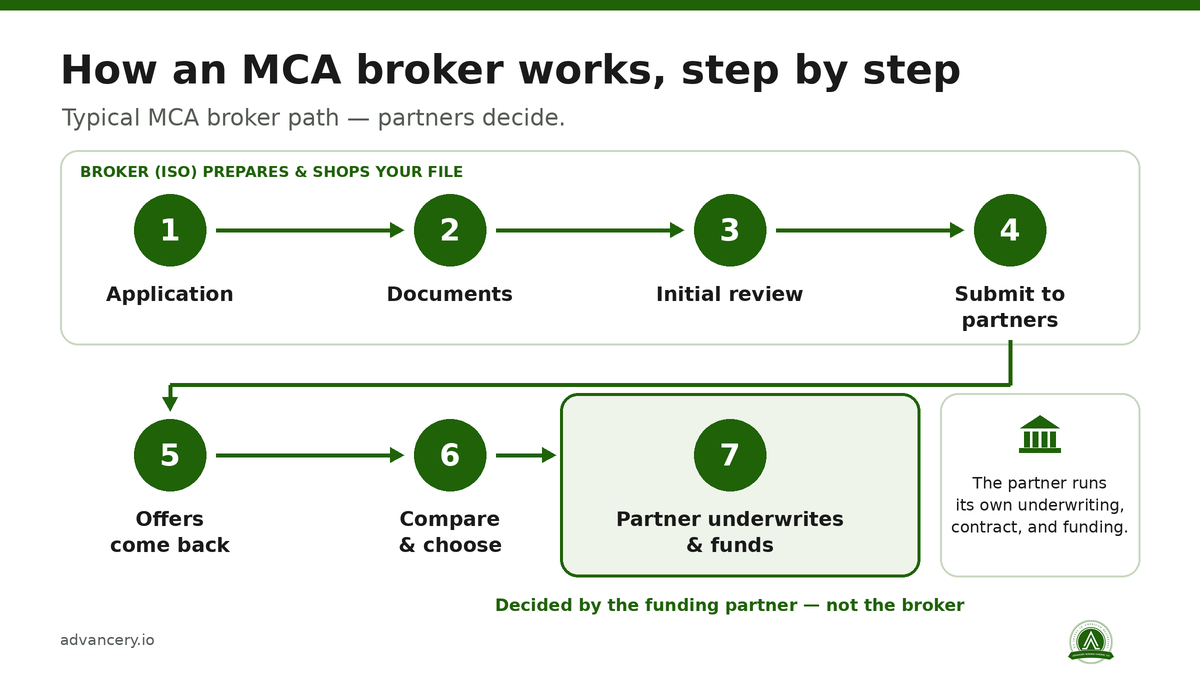
How an MCA broker works, step by step
The exact process varies by broker, but a typical path looks like this:
- Application. You fill out one application with basic business details: time in business, monthly revenue, industry, and how much you’re looking for.
- Documents. Most funding partners ask for recent business bank statements. Some also ask for ID, a voided check, or processing statements.
- Initial review. The broker checks that the file is complete and looks at which partner programs might fit. At Advancery, this first review may use a soft credit inquiry. The funding partner you move forward with may run its own credit check during underwriting, so ask what kind of pull to expect before you go ahead.
- Submission to partners. The broker sends your file to one or more funding partners whose guidelines appear to match your business.
- Offers come back. Partners that want to move forward send terms: amount, factor rate or rate, remittance, and term or estimated payback period. Some partners will decline, and that’s normal.
- Compare and choose. A good broker walks you through the total cost, how payments work, and the trade-offs, so you can pick the offer that fits your cash flow. You can also turn down every offer.
- Underwriting and contracts. The partner you choose finishes its own underwriting and verification. It issues the contract and handles funding if it approves. Timing depends on the partner and on how fast documents get signed and verified.
MCA broker vs. direct funder: what changes for you
| Going through an MCA broker (ISO) | Going direct to one funder | |
|---|---|---|
| Applications | One application, presented to several partners | One application per funder |
| Number of offers | Possibly several to compare | One yes/no from that funder |
| Who decides | Each funding partner underwrites and decides | The funder underwrites and decides |
| Who explains the options | The broker helps you compare terms across partners | You compare on your own |
| How the intermediary is paid | Usually a commission from the funding partner | No intermediary |
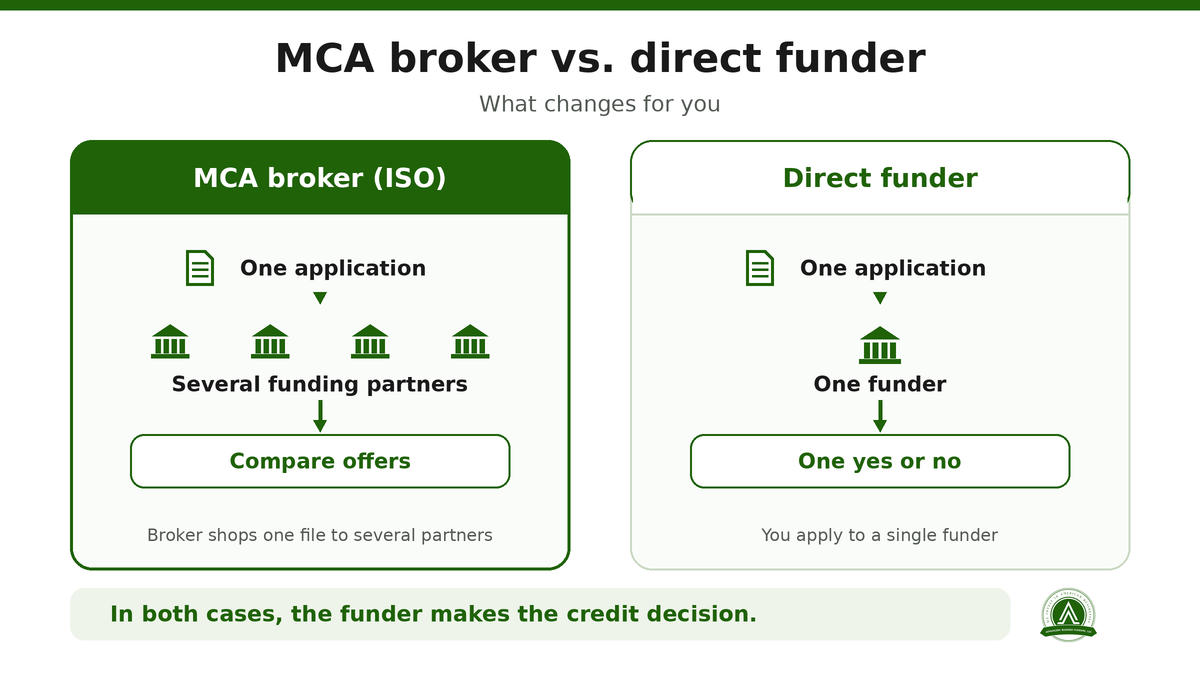
In both cases, the funder makes the credit decision. A broker changes how many doors your file reaches and how much help you get comparing offers. It doesn’t change who approves the deal.
How do MCA brokers get paid?
Most MCA brokers are paid a commission by the funding partner when a deal funds. That compensation may be reflected in the pricing of the offer. Before you sign, it’s fair to ask:
- “How are you paid on this deal, and by whom?”
- “Will I pay any fee to you directly, before or after funding?”
- “Is your compensation included in the terms I’m looking at?”
A reputable broker will answer plainly. If a broker dodges the question or asks you to pay a fee before you’ve seen any offer, treat that as a warning sign (see red flags below).
Who should use an MCA broker, and who might go direct
A broker may make sense if you:
- Don’t have time to research and apply to several funders yourself
- Were declined by one funder and want to know whether others see your file differently
- Want several offers to compare instead of a single take-it-or-leave-it quote
- Aren’t sure whether an MCA, term loan, line of credit, or equipment financing fits your situation best
Going direct may make sense if you:
- Already have a funder or bank relationship you trust and a clear offer in hand
- Want to deal with only one company from start to finish
- Have already compared the market yourself and know which product you want
Neither path is “right” for everyone. What matters is that you understand the offer you sign.
Red flags when working with an MCA broker
Watch out if a broker:
- Guarantees approval. No broker can promise that. Funding partners make every decision.
- Asks for an upfront fee before any offer exists.
- Pushes you to take a second or third advance (“stacking”) without walking through how the combined payments affect your daily cash flow.
- Won’t explain the total cost. You should be able to see the funded amount, the total payback, and the payment schedule.
- Claims to be the lender when it’s actually passing your file to someone else.
- Rushes you to sign without time to read the contract.
For more on spotting bad actors, see our guide to merchant cash advance scams and how to choose the best MCA provider.
How Advancery works as an MCA broker
Advancery is an independent business funding broker (ISO). We don’t lend, and we don’t make funding decisions. Here’s what we do:
- Review your file: your application, bank statements, and goals
- Match and shop it to third-party funding partners whose programs look like a fit
- Help you compare the offers that come back, in plain language
- Stay with you through the partner’s underwriting and contract steps
Specialties we shop for:
- Merchant cash advance and revenue-based financing / working capital
- Term loans
- Lines of credit
- Equipment financing
If you’re interested in SBA financing, tell us. We can check whether a partner path might fit, but SBA isn’t one of our core specialties.
Want to see who’s out there first? Browse our list of merchant cash advance companies, or learn more about Advancery.
Frequently asked questions about MCA brokers
Is an MCA broker (ISO) a lender?
No. An MCA broker, also called an ISO, is an intermediary. It presents your application to funding partners. The funding partner underwrites the file, decides whether to approve it, sets the pricing, and provides the funds. Advancery is a broker and is not a lender.
What does ISO mean in merchant cash advance?
ISO stands for independent sales organization. In the MCA industry, it means a broker that sources and presents merchant applications to one or more funding companies. “MCA broker” and “MCA ISO” are used interchangeably.
Does an MCA broker run a hard credit check?
It depends on the broker and the funding partner. Advancery’s initial review may use a soft credit inquiry. A funding partner may run its own credit check during underwriting, so ask your broker what type of pull to expect before you move forward with an offer.
Do I pay the MCA broker directly?
Usually not. Most MCA brokers are paid a commission by the funding partner when a deal funds, and that compensation may be reflected in the offer’s pricing. Ask any broker how they’re paid and whether you’ll owe them any fee directly.
Can an MCA broker guarantee approval?
No. Only the funding partner can approve a merchant cash advance or other financing, and approval depends on its own underwriting. Be cautious with any broker that promises guaranteed approval.
Is it better to use an MCA broker or go direct to a funder?
A broker can put your file in front of several funding partners and help you compare offers. Going direct means working with a single funder. If you want options and help comparing terms, a broker may fit. If you already have a trusted funder and a clear offer, going direct may be simpler.
What do I need to apply through an MCA broker?
Most funding partners ask for a short application and recent business bank statements. Some also request ID, a voided business check, or card processing statements. Requirements vary by partner and product.
Will using an MCA broker cost more than going direct?
Not necessarily. Broker compensation is usually built into the funding partner’s pricing, and direct funders price in their own costs of finding customers too. The useful comparison is the full offer: total payback, factor rate, fees, payment amount, and term. A broker that brings you more than one offer can make that comparison easier.
How do I know if an MCA broker is legitimate?
A legitimate broker uses a real business name and address, says plainly that it is not the lender, tells you which funding partner is making the offer, and puts every fee and term in writing. Be cautious of guaranteed approval, fees charged before you receive an offer, pressure to sign the same day, or advice to stop paying an existing funder.
Can an MCA broker help if I have bad credit?
Possibly. Many MCA funding partners weigh recent revenue and bank activity alongside credit, so a broker may know partners whose criteria fit a lower score. The funding partner still sets approval, pricing, and terms, and a weaker credit profile can mean a higher cost or a smaller offer.
How long does funding take through an MCA broker?
It depends on the funding partner, the product, and how quickly your documents come in. Some partners may decide within a business day and fund soon after contracts are signed; others take several business days. A complete file helps, but timing is never guaranteed. See our same-day funding timelines and document checklist.
Can an MCA broker help me refinance or consolidate an existing advance?
Sometimes. Some funding partners offer renewals, refinancing, or consolidation for existing MCA balances, depending on your payment history and revenue. Compare the total cost of any new offer with what you owe today, and be cautious of anyone who tells you to stop paying a current funder.
See which funding partners may fit
If you’d like a broker to shop your file instead of applying funder by funder, see which funding partners may fit by starting the 5-minute application. Funding isn’t guaranteed, and every decision is made by the funding partner.
Prefer to talk it through first? Call (844) 423-8623.
Advancery Business Funding, LLC is an independent business funding broker (ISO) and is not a lender. Funding is provided by third-party funding partners, who make all underwriting, approval, pricing, and timing decisions. Some partner products, such as merchant cash advances, are purchases of future receivables and are not loans. Funding is not guaranteed.
Office: 1151 Broad Street, Suite 212, Shrewsbury, NJ 07702.