
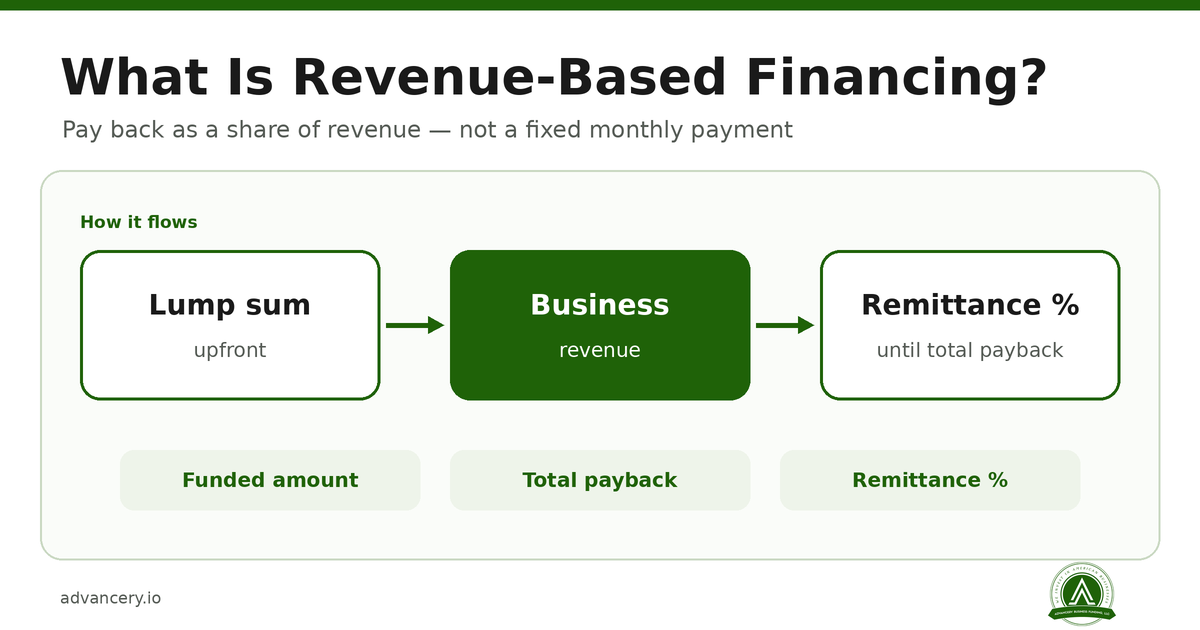
Quick answer: Revenue-based financing (RBF) is a lump sum repaid as a share of future sales or deposits until a set total is paid, not as a fixed monthly loan payment. For Main Street businesses, RBF and a merchant cash advance (MCA) are the same product family. A factor rate sets the total payback; a holdback or remittance is the share collected.
Advancery Business Funding, LLC is an independent business funding broker (ISO) in Shrewsbury, NJ. We review your business information and present it to third-party funding partners, who make all underwriting, approval, and pricing decisions. Advancery is not a lender. Advancery may receive compensation from funding partners. Funding is not guaranteed.
What is revenue-based financing?
Revenue-based financing is a way to get capital now in exchange for a portion of the revenue your business brings in later. Instead of a set loan payment due on the first of every month, the payment is tied to how much money actually comes through the business.
Three numbers define almost every RBF or MCA offer:
- Funded amount: the cash you receive.
- Total payback amount: the total you will repay. It is usually the funded amount times a factor rate (also called a multiple).
- Holdback or remittance: the share of revenue, card sales, or bank deposits the partner collects, often daily or weekly, until the total payback is reached.
There is typically no interest rate that keeps accruing over time. You owe the agreed total, and the speed at which you pay it off depends on your sales and on whether the contract uses a true percentage or a fixed remittance. Some products are structured as purchases of future receivables, not as loans. Others may be loans. Read your contract.
Most general-interest articles about RBF are written for venture-backed software companies. This page is for Main Street businesses — restaurants, auto shops, contractors, retailers, salons, and practices with documentable deposits — that want working capital that can move with sales.
How do the factor rate, holdback, and remittance work?
A factor rate is a multiplier, not an interest rate. If a partner offers $50,000 at a factor rate of 1.35, the total payback is $50,000 × 1.35 = $67,500. That $67,500 is the amount the contract is built to collect, before any separate fees named in the agreement. Factor rates are set by the funding partner. They are not a published Advancery rate, and the figures in the next section are examples only.
A holdback (sometimes called a split) is a percentage of card sales or, in some contracts, of bank deposits. If the holdback is 10% and you run $2,000 in card sales that day, $200 is remitted toward the payback balance.
A remittance is the actual transfer. Some contracts remit a true percentage of that day’s or week’s sales. Others use a fixed daily or weekly ACH amount based on recent average sales. Fixed-ACH contracts may allow a reconciliation if sales change, depending on the agreement. Ask how the partner collects, how often, and what happens if sales drop.
Payments that follow sales can protect cash flow in a slow month. The total cost can still be higher than a bank term loan. Compare the total payback amount, not only the daily or weekly remittance. The MCA calculator is a way to run the arithmetic. It is not a quote.
Ask each partner whether paying early lowers the total. Some contracts offer an early-payoff discount. Many do not.
What does a revenue-based financing example look like?
Example only. These numbers are illustrative. They are not an offer, a typical rate, or a prediction of what a funding partner would approve.
Imagine a retailer that is offered, and accepts, the following terms from a funding partner:
| Item | Example figure |
|---|---|
| Funded amount | $50,000 |
| Factor rate | 1.35 |
| Total payback | $67,500 |
| Holdback / remittance | 10% of daily card sales |
| Example average daily card sales | $2,000 |
| Example daily remittance | $200 (10% of $2,000) |
| Example time to repay at that sales pace | $67,500 ÷ $200 = 337.5 days, or about 11 months |
If card sales later average $1,000 a day, the daily remittance in this example falls to $100, and the time to repay stretches. If sales average $3,000 a day, the daily remittance rises to $300, and the balance is paid faster. The total owed in this example stays $67,500 unless the contract says otherwise.
A different contract might use a fixed $200 daily ACH instead of a 10% holdback. In that case, the daily amount would not automatically fall when sales slow, unless the merchant requests and receives a reconciliation the contract allows.
This is one worked example. Your offer, if a partner makes one, will use that partner’s own figures. For a step-by-step of the factor-rate math, see what a factor rate is.
How does the process usually work?
The details vary by funding partner, but the basic path looks like this:
- You apply. You share basic business details and recent bank statements so the partner can see your revenue pattern.
- The partner sizes the offer. The funded amount usually depends on monthly revenue and how consistent it is. The partner sets the total payback and the remittance method.
- You receive the funds. If the partner approves and you sign, the partner sends the money to your business bank account.
- Remittances follow the contract. Collections are often made by ACH or by a split of card processing.
- The deal ends when the total is paid. Once the payback amount has been remitted, the advance is complete.
Advancery prepares and shops the file. Underwriting, the contract, and funding are the partner’s call. Timing after approval and signed documents can be relatively quick with some partners, but it is not guaranteed.

How does MCA/RBF compare with a term loan or a line of credit?
For Main Street businesses, revenue-based financing and a merchant cash advance are basically the same product family. The real comparison is how MCA/RBF stacks up against a term loan or a line of credit:
| Merchant cash advance (MCA/RBF) | Term loan | Line of credit | |
|---|---|---|---|
| What you get | Lump sum | Lump sum | A credit limit you draw from as needed |
| How you repay | A share of revenue or deposits, or a set remittance, until a set total is paid | Fixed payments of principal plus interest over a set term | Payments on what you have drawn, plus interest or fees |
| Do payments move with sales? | Often, on percentage-of-sales deals | No | No. The payment is based on your balance |
| Is it a loan? | Generally structured as a purchase of future receivables, not a loan. Read your contract. | Yes | Yes, a credit product |
| Cost is shown as | Factor rate / multiple and total payback | Interest rate (APR) and fees | Interest rate and draw or maintenance fees |
| Often used for | Working capital, inventory, seasonal gaps | Planned purchases, expansion, refinancing | Ongoing or uneven cash needs |
Term loans and lines of credit may cost less over time but often require stronger credit, more time in business, or more paperwork. Each partner sets its own requirements. For a fuller side-by-side written as a comparison page, see MCA vs. line of credit vs. term loan.

Who revenue-based financing may fit
RBF may be worth a look if your business has consistent card sales or bank deposits, seasonal swings, a specific growth expense with a clear payoff, or little interest in pledging real estate or other hard collateral.
It may be a weaker fit if your revenue is very new or hard to document, you need long-term lower-cost money for a large purchase (a term loan or equipment financing may cost less over time), your margins are already thin, or you already have one or more advances open. Stacking remittances can strain daily cash flow quickly.
What do funding partners typically review?
Every partner has its own guidelines. Most RBF files come down to recent business bank statements, time in business, monthly revenue and any card-processing statements, existing advances or loans, industry, and basic owner and business ID. A starting checklist is on merchant cash advance requirements.
What about credit? At Advancery, the initial review may use a soft credit inquiry. The funding partner you move forward with may run additional credit checks during underwriting, so ask what kind of pull to expect before you accept an offer. Credit history is usually one factor among several. Revenue and cash flow tend to carry a lot of weight in RBF decisions.
How does Advancery match RBF files to funding partners?
Advancery is an independent business funding broker, also called an ISO. We do not lend, and we do not approve or fund deals. (See what an MCA broker is.) We review your application and statements, shop the file to third-party funding partners whose RBF and working-capital programs may be a fit, and help you compare funded amount, total payback, remittance, and fees.
Besides merchant cash advances and revenue-based financing, we shop term loans, lines of credit, and equipment financing. Every underwriting, approval, pricing, and timing decision is made by the funding partner. Advancery may receive compensation from funding partners.
You can also read our overview of revenue-based financing options or compare RBF partners.
Frequently asked questions
Is revenue-based financing a loan?
It depends on how the contract is written. Some revenue-based financing is structured as a purchase of future receivables, similar to a merchant cash advance, and is not a loan. Other RBF products are structured as loans. Read the agreement or ask the funding partner which type you are signing.
Is revenue-based financing the same as a merchant cash advance?
For most Main Street businesses, basically yes. Funding partners often use the terms interchangeably for a lump sum repaid from a share of future revenue or receivables, priced as a total payback amount. Remittance details vary by partner, so compare the actual contracts.
How is a factor rate different from an interest rate?
A factor rate is a multiplier used to set a total payback amount. It is not an APR and does not accrue over time the way interest on a term loan does. A 1.35 factor rate on $50,000 means a $67,500 payback in the example above, regardless of whether you repay it in five months or twelve, unless the contract says otherwise.
Does revenue-based financing affect my credit?
It can. At Advancery, the initial review may use a soft credit inquiry. The funding partner may run additional credit checks during underwriting, and its reporting practices vary. Ask what to expect before you accept an offer.
How fast can revenue-based financing fund?
It depends on the partner, how complete your documents are, and how quickly underwriting and verification finish. Some partners can move quickly after approval and signed documents, but timing is not guaranteed.
See which funding partners may fit
If payments that can move with your sales sound right for your business, start the application. Funding is not guaranteed, and every decision is made by the funding partner.
Prefer to talk it through first? Call (844) 423-8623, Monday–Friday, 9 a.m.–6 p.m. ET.
Advancery Business Funding, LLC is an independent business funding broker (ISO) and is not a lender. Funding is provided by third-party funding partners, who make all underwriting, approval, pricing, and timing decisions. Many merchant cash advances, and some revenue-based financing agreements, are generally structured as a purchase of future receivables, not a loan. Read your contract. Advancery may receive compensation from funding partners. Funding is not guaranteed.
Office: 1151 Broad Street, Suite 212, Shrewsbury, NJ 07702. Phone: (844) 423-8623. Hours: Monday–Friday, 9 a.m.–6 p.m. ET.